max 12 participants5 exercises3 hours practisingopen & in-company
Straight talk
Why training often doesn’t give you what you came for.
That is rarely your fault. It is how the training was sold to you.
There are three kinds you meet everywhere. All three fail for a reason this book explains.
SOORT 01
The trick
A trainer learned one technique that worked for him, and wants to teach it to you. Exactly the way he does it.
One-way traffic, one dimension, and a simple promise: do this trick and it will be fine.
Why it doesn’t work
It worked for him because of his situation. You are standing somewhere else — and you take in his words from your own position.
SOORT 02
The sales pitch
Announced as free training. In reality a well-built story, after which you get to order the real training.
With every familiar lever attached. Decide now, the price goes up tomorrow. It normally costs ten thousand, today one thousand.
Why it doesn’t work
That isn’t urgency, it is pressure. Pressure comes from him, and the moment you leave the room it is gone.
SOORT 03
The motivational high
A story that lifts you up. And it works — if you want to be motivated, the next day you genuinely are.
But can you win a client with it the day after, or solve your actual problem? After a few days the feeling is gone and you have to carry on. Often with an invitation to the next course.
Why it doesn’t work
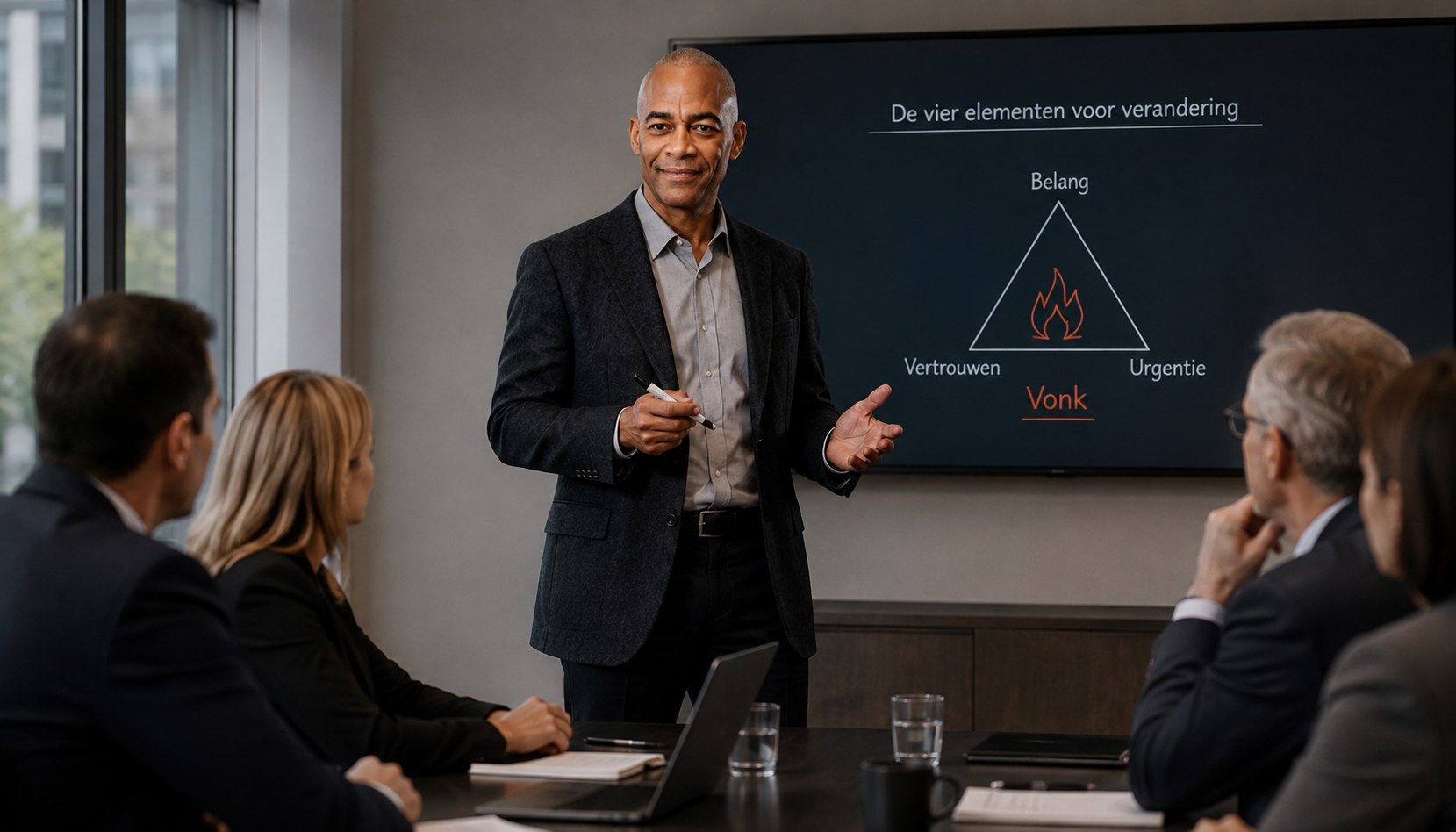
Motivation is heat. And heat alone doesn’t make fire.
I’m not saying you get nothing out of them. That is yours to judge. But once you see the pattern, you recognise it in time.
What you get here
No pitch, no trick and no product at the end.
The day is built to give you the tools to take the next step yourself. If you need more afterwards, you hire me and I come and stand beside you. You get what you paid for, not an offer for the next thing.
Why it usually doesn’t stick
The month after the training is the real problem.
Anyone who starts working this way looks slower for the first month. You produce fewer proposals. You have more second conversations. You say more often that this isn’t the moment yet.
And then your manager, your partner or your own impatience tells you to work harder.
That is the fourth match pulling at you.
Chapter 27 · The Fire Card
That is why this day is built so you walk out with something concrete rather than with insights. One completed Fire Card and one step you can take tomorrow morning. Insights don’t survive that first month. An appointment in your diary does.
The programme
The day is the Fire Path.
The eight steps aren’t explained to you. You walk them, on your own stuck situation. That is deliberate: this book is about order, so the day sticks to it.
09:30
ArrivalCoffee. Your stuck situation is already on the table, because you sent it in beforehand.
10:00
The thing that never movesEXERCISE 1Everyone writes one sentence about something that hasn’t moved for months. Then one question around the room: which of the three is missing? Anyone offering a solution is interrupted.
10:45
The triangleOnly now the explanation. Not as theory, but as an account of what you did yourself half an hour ago.
11:15
Break
11:30
Rewinding the conversationEXERCISE 2In pairs, with only two questions: what did he literally say, and what did you fill in? The assumption is almost always in the second or third sentence.
12:30
Lunch
13:15
Trust and positionsThe four trust questions, and the three positions somebody looks at your proposal from.
13:45
The four positionsEXERCISE 3One real situation, played three times. Same content, same proposal. You hear yourself say the same thing three times and watch it land three different ways.
15:00
Break
15:15
The design flawEXERCISE 4In-company: one process that has run this way for years, against three questions. On an open course we swap cases, because there is no shared process.
16:20
The smallest stepEXERCISE 5Write down the first step you were going to ask for. Make it three times smaller. What is left is almost always the step you should have asked for.
16:45
The Fire CardYou fill it in on your own situation. The empty boxes are your conversation plan for tomorrow.
17:00
EndNo closing speech, no offer. You leave with one step you can take tomorrow morning.
The times are a guide. If an exercise lands hard somewhere, it gets the room and the rest shifts along.
The eight exercises
Everything is about your own situation.
No role-plays with invented clients. You bring your own stuck conversation, and that is the material all day.
EXERCISE 1
The thing that never moves
20 minutes · whole group
Everyone writes down one thing that hasn’t moved for months. One sentence, no explanation. Then the round isn’t about solutions but about one question: which of the three is missing?
Anyone who offers a solution is interrupted. That is part of the exercise.
EXERCISE 2
Rewinding the conversation
30 minutes · in pairs
Take a conversation that stalled. The other person asks only two questions, over and over: what did he literally say, and what did you fill in?
The penny usually drops within ten minutes.
EXERCISE 3
The four positions
45 minutes · in groups of four
One person brings a real situation. The other three play the same counterpart from the three positions: submissive, assertive, dominant. Same content, same proposal, three times.
This is the exercise that lands hardest.
EXERCISE 4
The design flaw in your own house
60 minutes · team or leadership
Pick one process that has run this way for years. A job advert, a proposal route, a meeting structure. Three questions: what assumption about people sits underneath it, who ever checked that, and what are we actually measuring?
This one can get painful. On an open course we swap cases instead.
EXERCISE 5
The smallest step
15 minutes · alone
Take a proposal you are about to make. Write down the first step you were going to ask for. Then make it three times smaller.
What is left is almost always the step you should have asked for.
Who for
When this day makes sense.
Yes
You have to get people moving without being able to order them to.
You currently have one situation that hasn’t moved for months.
You are looking for closing techniques or objection handling. This isn’t about that, and that is exactly the point.
You want the day as a reward or a team outing. Exercise four can get painful.
You have no concrete situation to bring. Come back another time.
No prior knowledge needed. You will get more out of it if you have read the book — chapter 1 is free here.
Two formats
Open, or at your office.
Same day, same exercises, but not the same product. Exercise four only really works when the whole group shares one process. Exercise three works better between strangers.
Open course
€ 895 p.p.
excl. VAT · maximum 12 participants
Your own craft is the focus
Strangers play each other’s counterpart more honestly than colleagues do
Venue by arrangement — at your office or elsewhere. For the open course I first collect enough registrations for a full group, then we set a date. I don’t fill half a room with a countdown clock.
Afterwards
The follow-up session.
Ninety minutes online, six weeks later. One question: what slipped back?
Six weeks isn’t arbitrary. That is exactly the point where it starts to feel slower and somebody around you says you should work harder.
Bookable separately, and I only offer it when you are ready. Not on the day itself, because then I would be doing exactly what this book warns against.
Follow-up session
€ 195 p.p.
excl. VAT · 90 minutes online
Six weeks after the training
What slipped back, and why
With your Fire Card to hand
Maximum 12 participants
Live every month · The Fire Hour
Not ready for a whole day?
Start with an evening. For thirty-nine euros you put your own situation forward and hear what I would do. If you like it, you know straight away whether the training is for you.