The book

Thirty chapters.One question.

Why don’t people move when the solution is right in front of them? This book follows that question from a kitchen table in the Netherlands to a call centre in Manila, and arrives at a model everybody already knows.

You can read chapter 1 in full below. Not an extract, not the first page. The whole chapter.

30 chapters 4 parts 442 pages 5 appendices
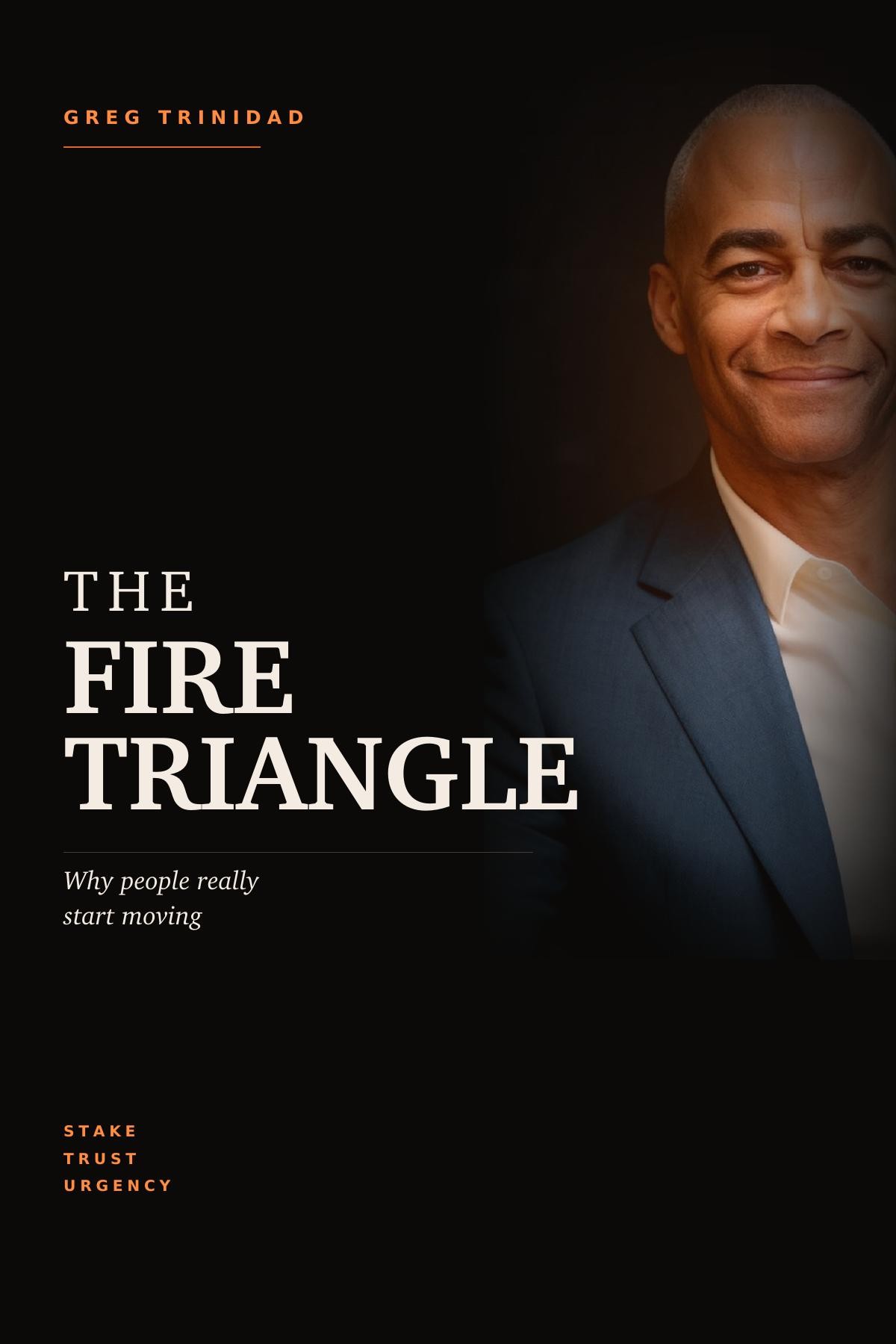
Cover of The Fire Triangle — Why people really start moving, by Greg Trinidad
NL EN

Chapter 1 · free to read

Everyone was right. And still nothing happened.

“The biggest discoveries rarely begin with an answer. They begin with a question that won’t leave you alone.”

There are questions that stay with you.

Not because they’re complicated.

Precisely because they look so simple.

Why do some business owners buy and others don’t?

Why does one manager get a team moving without effort, while another keeps pushing and pulling and gets nowhere?

Why can some organisations reinvent themselves again and again, while others talk about it for years without a single thing changing?

Those questions kept me busy for a long time.

Not from a textbook.

From the road.


In the late nineties I worked as a financial adviser.

The job was simple.

I helped people arrange their financial future.

At least…

…that’s what I thought.

Every day I drove to people’s homes with a folder under my arm.

I was well prepared.

I knew the products.

I knew the numbers.

I knew the tax rules.

I had been taught how to handle objections.

I knew exactly which benefits to name.

I did everything by the book.

And still…

…most people bought nothing.


That struck me as odd.

Because I wasn’t selling a luxury.

I was selling something almost everyone would need sooner or later.

A supplementary pension.

Who wants less money later?


So I opened my conversations the way I had been taught.

“Good afternoon. I’m here to help you get your pension properly arranged.”

And almost every time I got the same answer.

“What do you mean? My pension is fine, isn’t it?”

I explained that it could be better.

That there were tax advantages.

That an annuity would give them extra security.

That it was sensible to look ahead now.

And almost every time, the conversation ended the same way.

“We’ll think about it.”

Or, more honestly:

“We don’t really need this.”


I drove home with a head full of questions.

Why couldn’t they see what I could see?

Why would people refuse to solve a problem when the solution was sitting on the table in front of them?


So I did what most salespeople do.

I decided to get better.

I took more training.

Learned new techniques.

New arguments.

New closing questions.

New ways of handling objections.

I got better and better…

…and the results barely moved.


Looking back, I was doing exactly what most people do when something doesn’t work.

I kept reaching for another match.


There is a comparison that made this clear to me later, and it comes from medicine.

No doctor starts with the treatment.

A doctor starts with the complaint, examines, makes a diagnosis, and only then treats.

That order isn’t up for debate. It is the foundation of the profession.

The doctor’s order, and the reverse order I kept to HOW A DOCTOR WORKS Complaint 1 Examination 2 Diagnosis 3 Treatment 4 Look first. Act afterwards. HOW I DID IT Complaint skipped Examination skipped Diagnosis skipped Treatment and when it didn’t work: explain it better
No doctor starts with the treatment. I did, for twenty years.

I kept to exactly the reverse order.

I walked in with the treatment.

And when it wasn’t accepted, I explained it better.


The turning point didn’t come during a course.

Not during a sales training.

And not because I got a better product.

It came from something much simpler.

I stopped talking.

And started looking.


I stopped looking at the policy.

Not at the pension statement.

Not at the tax advantages.

I looked at the people.

I saw photographs of children on the wall.

I saw two cars in the driveway.

I saw a caravan beside the house.

I saw a dog come bounding towards me.

I saw a family that was visibly happy.


And for the first time I didn’t ask the question I always asked.

“So how is your pension set up?”

I asked something else entirely.

“What a beautiful place you have here. Have you lived here long?”


The room changed immediately.

There was laughter.

Stories came out.

About the children.

About holidays.

About the renovation.

About the neighbourhood.

About plans for the future.

For the first time I wasn’t having a sales conversation.

I was having a conversation with people.


Only much later did we get out the pension papers.

We looked at their current income.

Then at the pension they could expect.

I explained nothing.

I just pointed at the numbers.

Then I asked one question.

“You like the way you live now, don’t you?”

They nodded.

“Yes, of course.”

I pointed at the numbers again.

“And honestly — do you think this income will be enough to keep living like this?”


It went quiet.

They weren’t looking at me any more.

They were looking at each other.

I will never forget that moment.

Because right there, something happened.

Not in my head.

In theirs.

I had nothing left to sell.

I had nobody left to convince.

I only had to ask one more question.

“Would you like me to help you close that gap?”


Everything changed from that point on.

Not just my sales figures.

My way of looking.


Twenty years later I finally understand what happened that afternoon.

I wasn’t selling a pension.

I wasn’t selling an annuity.

I wasn’t even selling financial security.

What I was doing…

…without knowing it…

…was something else entirely.

I was lighting a fire.


That night I sat at my own kitchen table.

I often did, after a working day.

Not because I enjoyed the paperwork.

But because I wanted to understand why one conversation flowed and another went nowhere.

My diary was open.

I could see the names of the clients who had said yes.

And beside them, the ones who wanted to think about it.

I started reconstructing what had actually happened.

Not what I had said.

What they had said.

That turned out to matter.


In the conversations that failed, I had been talking almost the whole time.

I told.

I explained.

I supported my case.

I persuaded.

I defended my advice.

In the conversations that worked, the opposite happened.

There, the client talked.

About his children.

His plans.

His business.

His house.

His future.


And then something struck me.

In the successful conversations I had barely mentioned my product at all.

In fact…

The less I talked about what I was selling, the more likely people were to buy it.

That couldn’t be right.

Every sales training I had ever taken taught the exact opposite.

There I learned to name benefits.

To handle objections.

To use closing techniques.

But nobody had ever taught me to be curious.


FIRE INSIGHT

I wasn’t selling a pension.

I wasn’t selling an annuity.

I wasn’t even selling financial security.

I made it possible for somebody to understand something about their own life.

The rest followed from that.


I started replaying my own conversations as if watching a film.

Over and over.

Until one question started pressing itself on me.

When did that client actually decide?

Not when he signed.

That was only the consequence.

But when did he really make the decision?


I kept arriving at the same moment.

Not when I explained my solution.

Not when I named the benefits.

Not when I started on tax advantages.

No.

The decision seemed to have been made much earlier.

At the moment the client saw something about himself.

I didn’t have to convince him any more.

He convinced himself.


That was new to me.

And honestly, a little uncomfortable.

Because if that was true…

…it meant I had been asking the wrong question for years.

I kept asking myself:

“How do I convince somebody?”

Perhaps I should have been asking:

“Under what conditions does somebody convince himself?”

That is a completely different question.

And looking back… that may be the most important question I have ever asked.


FIRE INSIGHT

As long as the problem was mine, nothing was wrong.

The moment the problem became theirs, there was a problem.

And only then could I help.


THE CLOSING QUESTION

If the decision was already made before I explained my solution…

…why did it take another twenty years to understand what was happening there?

Because I thought it was about pensions.

“The day I stopped convincing people, I started understanding how people really decide.”Chapter 13 · Heat

It carries on like that for another twenty-nine chapters.

You get Part I free as an e-book — the first six chapters complete. If you want the rest, it is below.

Live every month · The Fire Hour

You’ve read chapter 1. Come and put your situation forward.

One evening a month I go live with a maximum of twenty-five people. You bring one stuck situation, I say what I would do and why. Not a webinar, an open surgery.

Next: Thu 1 October
20:00 CET · max 25 people

See The Fire Hour · € 39

The contents

What’s in it.

Four parts. From the insight through the method to nine applications, and then to the tools to do it yourself.

PART I

The Fire

Why your best argument did nothing.

  1. 01Everyone was right. And still nothing happened. free
  2. 02Actually…
  3. 03Everyone knows how to make a fire
  4. 04The day I stopped selling
  5. 05The biggest mistaken assumption
  6. 06The fourth match
PART II

The Fire Path

Eight steps, and why the order decides everything.

  1. 07Decisions don’t happen. They’re designed.
  2. 08The design flaw
  3. 09Fuel — Stake
  4. 10How do you find somebody’s stake?
  5. 11Oxygen — Trust
  6. 12How do you build trust?
  7. 13Heat — Urgency
  8. 14How do you create urgency?
  9. 15The Spark
  10. 16The Fire Path
PART III

Where It Shows Up

Nine fields, one pattern.

  1. 17Sales
  2. 18Leadership
  3. 19Sustainability
  4. 20Onderhanparts
  5. 21Innovation
  6. 22HR & Recruitment
  7. 23Project management
  8. 24Strategy
  9. 25Personal development
PART IV

Become the Firemaker

From reading to doing.

  1. 26The Fire Diagnosis
  2. 27The Fire Card
  3. 28Exercises
  4. 29Checklists
  5. 30The campfire

From chapter 21

A tunnel under the sea. And empty trains.

In the nineties I worked at British Rail on the Eurostar project. I was allowed to shadow the marketing director as part of my studies.

What struck me was about photographs. Newspaper stories about Eurostar regularly ran a picture of the Shuttle — the car-carrying train, a completely different product. Including on critical pieces.

So I asked why we didn’t correct it.

“I don’t want too many people wanting to travel on Eurostar. We won’t have enough capacity at the start.”

I nodded. Because that sounded logical. You have a limited number of seats, you don’t want to create demand you can’t serve.

There was no stupidity in that answer at all. And it was completely wrong.

At the opening they were counting on ten million passengers a year by 1998. In 1995 it was 2.9 million. That ten million was reached — in 2013.

Meanwhile carriages were built for two services that never ran. Not a single paying passenger. In 2000 they were sold to a railway company in Canada.

On one side somebody holding back demand for fear of too little capacity. On the other, capacity built for trains that never left. The same wrong assumption, running both ways at once.

FIRE INSIGHT

Not the wrong step.

The wrong order.

People first have to know dát something exists. Then understand wat it does. Then be able to ervaren whether it works. And only then are they willing to betalen.

Four steps. You can’t skip one. Eurostar skipped the first two, out of fear of the fourth.

The figures in this piece are public and sourced at the back of the book. What I saw in London and what was said to me there is my own recollection.

Ordering

This is where you get the whole book.

Part I is and stays free. If you want the other twenty-four chapters, this is the way.

Available now
Digital
€ 14,95

E-book · epub and pdf

  • Alle 30 chapters
  • Five appendices, exercises and checklists
  • In your inbox straight after payment
  • Read on any device
Buy the e-book
On paper
€ 27,50

Paperback · 442 pages · autumn 2026

  • Alle 30 chapters
  • To write in and pass on
  • From the first print run
  • You only pay on despatch
Join the list
For your team
100+ copies

Company edition · price on request

  • Your own foreword possible
  • Your logo on the inside
  • Freely priced from 100 copies
  • Delivered to one address
  • Always starts with a baseline session
Request a baseline session

The Dutch paperback falls under the Dutch fixed book price act. Discounts are not permitted by law, except on orders of 100 copies or more.

The e-book

Available now.

All thirty chapters, five appendices, the exercises and the checklists. Epub and pdf, in your inbox straight after payment.

Payment runs through Mollie — card, PayPal or iDEAL, whatever is normal where you are. I never see your details. If something doesn’t work, email me and I’ll send the book manually.

The paperback

Why you can’t order yet.

I’ll be straight about where this stands.

The manuscript is finished. It is with the editor. After that it goes to the designer and only then to the printer.

So I know what the book is, but not yet when it lands on your doormat. And I’m not going to take money for something I can’t date.

What I do want to know is how many people want it. The first print run depends on that, and too small a run means months waiting for a reprint.

Hence this list. It is the oldest way of publishing there is: people subscribe in advance, and then it gets printed.

And yes, that is exactly what the book says.

On this page I am applying what chapter 15 describes.

I’m not asking you for a decision. I’m asking you for the smallest possible first step — one you can still walk away from tomorrow.

Your name on a list. No payment, no obligation, and one email when the book is ready.

If you change your mind then, that is fine. The fuel wasn’t there, and there is nothing to force about that.

Free · Part I complete

Six chapters. Nothing to pay.

You’ve just read chapter 1. You get the five that follow free as an e-book: the complete model, the four trust questions, the fourth match and the design flaw.

And as soon as the whole book is ready, you hear first.

Or download it straight away, without an email address. If you do fill it in, you’ll hear when the whole book is ready.

One email with the download. After that you hear from me occasionally, and you can leave with one click. Your address goes nowhere else.

Next

What isn’t moving for you?

Henk asks the first question of the Fire Diagnosis and works out which of the three is missing. It costs nothing and takes three minutes.

Greg Trinidad

FIRE INSIGHT

Waiting is the safest decision there is.
Chapter 13 · Heat