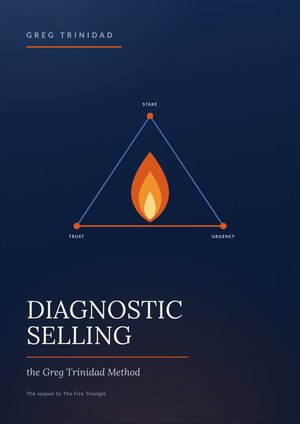
Diagnostic Selling is a sales method and sales-organization model in which the seller does not begin with persuasion, presentation or proposal, but first systematically diagnoses which of three conditions for a responsible decision is missing: Stake, Trust or Urgency.
The diagnosis then determines the smallest justified next step — including waiting, stopping, or not selling at all.
In the Greg Trinidad Method, this decision logic is translated into the entire commercial organization: from demand generation and qualification to connection, baseline assessment, confirmation, explicit agreement, contract, onboarding and aftersales.
Greg TrinidadDiagnostic Selling — the Greg Trinidad Method
Stake, Trust and Urgency are the fixed names of the three conditions. In Dutch they are belang, vertrouwen and urgentie, and the Fire Triangle is De Vuurdriehoek — not translations that may vary from one text to the next, but the same three quantities under two sets of names. The Dutch page is here.
Below, the method is written out: the diagnosis, the four questions, the six steps, and the quote that is no longer a moment of decision. And the book that holds all of it.
The diagnosis runs through stake, trust and urgency.
Look big. Decide small.
And that logic is used not only in a conversation, but across the whole sales organisation.
For anyone who has to pass it on.
The book
The book in which the method is set out in full.
BOOK TWO · 2026
Diagnostic Selling
the Greg Trinidad Method · the sequel to The Fire Triangle
Twenty-eight chapters in three parts. Part I explains where the method comes from: what selling and marketing actually are, where the money disappears, and why people would rather do nothing. Part II is the diagnosis itself. Part III builds the organisation: demand generation, qualification, connection, baseline, confirmation, agreement, onboarding and aftersales.
28 chapters · three parts · 427 pages
Part I free as pdf and epub — the first eight chapters
The complete first part as an e-book: two sales floors, what selling and marketing actually are, where the money disappears, sixty years of sales tactics, the road from offline to online, whether AI takes selling over, and why people would rather do nothing.
Enough to know whether the rest is for you.
The whole book · e-book € 12.99
The other twenty chapters.
Part I is free and stays free. If you want the diagnosis itself and the design of the organisation around it, this is the way. Twenty-eight chapters, 427 pages, epub and pdf, straight to your inbox.
A paperback edition will follow.
The method
Diagnostic selling: establish what is missing first.
Diagnostic selling is a way of selling in which you first establish which of the three conditions for a decision is missing — stake, trust or urgency — before you say, offer or send anything.
It is the application in sales of the Fire Triangle, the model from the book of the same name. The model describes how a decision comes about. Diagnostic selling describes what you do with that in a sales conversation.
The difference with the usual approach isn’t in what you say but in the order. Conventional selling starts with an offer and then looks for objections. Diagnostic selling starts with a diagnosis and only then comes to an offer — and that offer is a reflection of what the client told you himself.
In the wider field this sits under what is now called decision design: designing the conditions under which someone decides, rather than persuading them.
The comparison
A doctor doesn’t pitch.
You have stomach pain. A surgeon comes in, barely looks at you, asks no questions, does no examination, and after thirty seconds says: I know exactly what you need. Next week we take out your gallbladder.
You would run. Not because you are against surgery, but because you want to know first whether that surgery is necessary.
Now look at an average sales meeting. The adviser arrives with the solution already in his bag. The consultant has the deck ready. The supplier already knows which package he is going to offer.
Everyone starts with the treatment. Almost no one starts with the diagnosis.
A sales methodology is a treatment plan. SPIN, Challenger, MEDDIC: excellent tools, once you know what is going on. The problem isn’t the tools. The problem is that no diagnosis comes first.
Who this is for
Does this sound familiar?
Diagnostic selling is meant for people and organisations who notice their current approach fits less and less well. For instance because:
cold calling barely returns anything;
LinkedIn outreach mostly produces noise;
salespeople have many conversations but see few real decisions;
demos and pitches land earlier and earlier in the process;
quotes go out without it being clear why the client would decide;
everything is steered on activity: more calls, more meetings, more quotes;
everyone works hard and keeps running into the same objections.
It weighs heaviest in complex sales: higher order values, several decision-makers, a longer cycle. That is where the chance of one of the three conditions being missing is greatest, and the price of not noticing is highest.
A good salesperson doesn’t try to influence the decision first. He tries to understand first why the decision cannot yet come about.
The diagnosis
Three conditions. There are no more.
Diagnostic selling is the discipline of establishing what a decision needs before you try to sell that decision.
The old question
How do I get this client there?
The question that matters
What is missing that stops this client from being able to decide?
If one of the three is missing, nothing happens — however good the argument, and however often you call. That isn’t an insight about people in general. It is a diagnosis you can make about this one conversation, with three possible outcomes.
Why would I move at all?
Stake isn’t about your product, and not about a general customer need either. It is about what is at risk for this person, personally and professionally.
You don’t create stake. You discover it.
Whoever tries to create stake starts arguing. Whoever diagnoses makes visible what was already there.
How you notice it is missing
“Too expensive.” No one finds something too expensive when they feel its value. He sees the cost and not the return.
What you investigate
What happens now
What that situation costs him
What it means for him personally
The risk of doing nothing
What he would want instead
The stopping rule
If you find no personal stake, the conversation stops here. Trust and urgency repair nothing. Going on costs you four weeks and produces silence.
With all three present, the decision is possible. Nothing more. It can still stall when the first step is too big.
That is why diagnostic selling doesn’t end with “shall we sign the contract”, but with one question: what is the smallest logical next step?
Whatever it is, he has to be able to sign it alone. No board meeting, no procurement, no one else involved.
You never ask for the big decision. You ask six times for a small one.
That smallest step is not the spark. The spark is the moment he decides — and that moment is the email in which he says: start here. Not the contract.
The diagnosis in four lines
What he says, what is missing, what you do.
What he saysWhat is missingWhat you do
“Too expensive”StakeBack to his situation. Don’t calculate, don’t drop the price.
“I need to discuss it internally”TrustMake the step smaller. Take the risk off his shoulders.
“I’ll come back to you”UrgencyLet him rank it. What can wait, what can’t.
Nothing. Silence.Usually trustAn offer landed before he dared. Go back to the smallest step.
Conventional selling runs like this
Pitch
Objection
Argument
Close
→
Diagnostic selling runs like this
Look
Establish what is missing
Add only that
Determine the smallest step
Underneath trust
The four questions no one asks out loud.
In every conversation someone silently runs through four questions. They are in chapter 12 of the book, and the last one stalls the most deals.
Can I trust you?
Do you know what you are doing?
What happens if I say yes?
Can I handle this?
That last one is almost never spoken. Someone can have complete faith in your solution, trust you, understand the benefits — and still think: but can I do this myself?
So he says it differently. He says: the timing isn’t right. It has to be discussed internally. I want to think it over.
We hear an objection and set about fighting the objection, while the other person is only looking for certainty about what will be expected of him after his decision.
The question that opens it
Not: “are you up for this?” — that pushes someone towards a yes.
Instead: “what still has to happen before this feels right to you?”
Then you get information. And that information tells you where it is actually missing.
The process
Six steps. Each step is one decision.
This isn’t a conversation in which you ask questions and form a judgement. It is a sequence in which the buyer takes one small decision at a time — and never more than that.
That is the heart of it. Someone who has to take in a whole programme postpones. Someone who only has to decide on the next step, decides.
1 · Demand generation
This is where the pitch used to be: cold calls, cold email, convincing someone to buy your product. We don’t do that any more.
Instead you pull the client towards you. LinkedIn, video, email, your network, the closed channels where your peers are. You share what you know without conditions, and you wait until someone comes forward.
The lead comes in. Only then does the rest begin.
2 · Connection
You call to get acquainted. Nothing more.
You confirm you are speaking to the right person, that the request is what you think it is, and you ask for a short explanation. You sell nothing here and you name no solution.
The only purpose of this call is to book the substantive conversation.
3 · The baseline
A video call or a visit. Here you find out what is actually going on.
Do not name your solution. This is entirely about him and his company, and not about you.
This is where you find the stake. And it is the only place where you can — later it doesn’t surface any more.
If you find no personal stake, stop. Not later, here. One of the three conditions is already missing, and the other two will not make up for it. You can have urgency and trust in order and still never get a deal.
That sounds hard and it is the cheapest decision you will take that week.
4 · The confirmation
You switch to email. Not messaging.
You write down point by point what you heard, in his words, and you ask whether it is right. He may correct it.
There are almost always several problems. Name them all, and let him say which one comes first.
Look at what happens here
By letting him choose which problem has to be solved first, he names his own urgency.
You don’t have to add heat. He supplies it. That is the condition the book says you cannot force — and this is the form in which it arises on its own.
You always get an answer to this email. Always. Because you are not asking for a verdict but for a correction, and no one can resist setting straight something that is almost right.
5 · The agreement
You confirm his answers and keep fine-tuning until it is entirely clear what he wants done and what he wants to start with.
What he wants to start with is your smallest step. You offer a solution for that, with the price. And you sketch the route to the rest: what follows, when you pick it up, and what that costs as far as you know.
Then you ask whether this is agreed.
You always get an answer and usually an agreement. That is no accident:
The first step is small, so the risk is small.
You aimed the whole conversation at him, so you can be trusted.
You only now offer a solution, and only what he asked for.
He buys nothing he doesn’t need. That agreement is the deal.
6 · The paperwork
Only now do you say the contract is coming, and that he can accept it online.
Always online. Never a contract that has to be printed, signed, scanned and sent back — that is four actions between his yes and your assignment, and every action is a place where it can stall.
Then comes onboarding.
What used to be step four, the quote, has become step six. Nothing is decided on paper any more.
And this is where it goes wrong if you let go of the order. Send the quote before the agreement — because a colleague pushes for it, or because it feels faster — and it stalls. He has to say yes to what he actually wants first.
The price
Never a discount. A smaller step instead.
When someone finds it too expensive, the reflex is to take something off the price. That is the most expensive move there is.
A discount doesn’t lower the risk, only the amount. And it tells your client something you don’t want to tell him: that your price was negotiable, and that if he waits longer it might drop again. You buy urgency with trust.
Never change the price without changing the scope.
What you do instead: you make the offer smaller. Less scope, less depth, or a different division of the work. The client pays less and gets less — and that is honest, explainable and defensible.
The same goes for deducting. If a first step is taken off the price of what follows, that first step apparently wasn’t worth its own price. Every price is fixed for what you get. If the amount is too high, you take a smaller step.
Two from practice
This isn’t theory.
Two engagements from this month. Names left out, words not.
The first: the whole picture mapped, and still starting small
A business owner wants to move his bookkeeping and payroll filings. In the baseline the whole picture comes out: the bookkeeping, the payroll filings, the tax returns, and something he hadn’t formulated as an assignment at all — his daughters already work in the business and one of them will take it over. He wants that properly arranged.
That is the stake. Not the bookkeeping.
And that is exactly where the trap is. Send that whole picture back as a proposal — administration, filings, payroll, and a succession programme for his daughter — and it is too big. He would have to decide in one go about something he has no experience with, with a supplier he doesn’t know yet.
So the whole picture was mapped, and the first step was made smaller.
Start with the bookkeeping only.
The payroll filings stay with his payroll administrator; the annual accounts and tax matters stay with his current accountant.
The handover to his daughter is built up along the way. First step: we teach her how the bookkeeping works.
The rest of his assignment hasn’t disappeared. It is mapped and will be carried out in steps, in the order he sets himself. He starts with whatever is most pressing for him.
Step 4 · the confirmation
“You want to move the bookkeeping and the payroll filings to us. But the most important thing you gave me is something else: your daughters already work in the business and one of them will take it over. You want that properly arranged.”
“My question to you: is this what you expect from us, given what we discussed? If something is missing or you had it differently in mind, I’d like to hear it. Then I’ll adjust it before we begin.”
He confirms, and then answers four practical questions: thirty to forty transactions, bank linked, everything digital, invoicing he keeps doing himself. That is the baseline, carried out by the client.
Step 5 · the offer, with an unusual heading
“What is not included. Your annual accounts, corporate tax and tax advice stay with your current accountant. The payroll filings stay with your payroll administrator. Nothing changes there.”
“With your agreement I’ll contact your accountant myself about the handover, so you don’t have to be the messenger.”
“€ 100 a month, all in. Fixed amount, no true-up, no hourly billing for a question in between.”
That heading — what is not included — isn’t modesty. It makes visible how small the step is. He has to cancel nothing, hand over nothing, defend nothing to his accountant.
The answer came the same morning:
“All good, here is my agreement.”
Only then did the quote go out. Six days, four emails, not a single objection handled.
The second: too expensive, and agreed anyway
A business owner wants a holding structure with his sole trader business inside it. Here too the whole picture was mapped: incorporation, transfer, administration, filings. And here too, as a whole, it was more than he wanted to spend.
This is where most salespeople go wrong: they either defend the price or give a discount. Neither happened. Instead the offer was made smaller: set up the companies yourself, and we do the rest. Less money, less work, and a step he could oversee himself.
What happened next is the interesting part. He came back with seven points — the director’s administration, the notice period, the VAT returns, an insurance certificate, when invoicing starts. And underneath, this sentence:
“If these things can be put in order I’ll sign straight away.”
That is not an objection. That is a buyer putting his own conditions for a yes on the table, point by point, unprompted. You only get that when the step is small enough to negotiate about.
The answers went back point by point, including two noes: there will be no professional indemnity certificate, and the holding is not a financial one. The onboarding fee was dropped.
Note that last one, because it looks like a discount and isn’t. The price of the work stayed. What fell away was a threshold item that had nothing to do with the value.
His reply: “tonight I’ll do one last check and then I’ll accept it.” That same evening: “I’ve replied to the email.”
And look at who was in a hurry. Not the seller. He wanted to sign that same day. That is urgency arising the way it should: out of his situation, not out of a deadline someone invented.
One thing here didn’t go by the book, and it is worth saying: the paperwork went out before the agreement, because the organisation this ran for hadn’t made that step yet. It worked anyway, but it does explain those seven questions. Had the offer been confirmed first, they would have been in one email instead of a series of messages.
And the core still holds: had he received the quote for the full package, it would have stayed quiet. Too expensive, too much, too big. The deal existed only because the first step was made smaller.
Beside the existing methods
What this does and doesn’t replace.
This doesn’t replace SPIN, Challenger or MEDDIC. Those methods describe what you do. This model explains why it works or doesn’t, and therefore when to use which.
SPIN questions are a way to uncover stake.
The Challenger approach is a way to create urgency.
References and case studies are a way to build trust.
MEDDIC mostly tests whether the stake is real and who decides.
All useful. And all useless the moment you aim them at the wrong element: create urgency for someone who doesn’t yet see the stake, and you push harder on a conversation that is stuck on something else.
The term diagnostic selling isn’t new. In Mastering the Complex Sale, Jeff Thull described the salesperson as a physician, and that image still holds. The difference is in what the diagnosis establishes. With Thull you establish the client’s problem. Here you establish which condition for his decision is missing — three possible outcomes, each with a different next move.
That makes it usable at the moment things go wrong: not at the start of a process, but at the proposal that has been sitting still for three weeks.
Starting
Three questions for the conversation that is stuck.
You don’t have to introduce or change anything for this. Take one conversation you haven’t heard from in weeks and answer three questions.
Do I know what it personally gains or saves him?
Does he dare take this risk, with me?
Is there a reason it has to be this month and not in March?
Your work lies on the question you cannot answer.
If you can answer all three and still nothing happens, the spark is missing: there is no moment at which he can decide. Make that moment.
Applying Diagnostic Selling in your organisation?
This site is about the books and the method; nothing else is sold here. The implementation and build of Diagnostic Sales Organisations runs through Digital Sales Consultant.